‘Robbing Peter to pay Paul’
In his opinion piece, Schaefer wrote that “reductions in the amount of water available downstream will harm Missouri agriculture, utilities, public water supplies, power plants, navigation and the greater inland waterway system.”
Shane Kinne, executive director of the Coalition to Protect the Missouri River, a group of lower-basin stakeholders, said that “when you start the process of moving water out of one basin into another, it kind of comes back to robbing Peter to pay Paul.”
“You may be solving one issue, but you’re exacerbating or causing another issue in another basin that will have to be solved,” he said.
The U.S. Army Corps of Engineers has already limited releases from upriver dams in recent years due to drought. Kinne said that hurts Missouri power plants, many of which rely on the river for cooling water and would shut down without it.
“Often, those plants are measuring their access to water in inches,” he said. “That just highlights that even the tiniest amounts of flow are really critical.”
Low river levels also have implications for the state’s businesses, Schaefer said.
“A million tons of sand and gravel are shipped by barge in and out of the Kansas City region on the Missouri River every year, and up to 300,000 tons of soybeans make their way to the world on the river, as do nearly 270,000 tons of asphalt, cement (and) concrete,” he said.
Lower water levels limit how much barges can carry, raising costs, Kinne said.
There are also implications for municipal water systems, including Kansas City and St. Louis, which draw most of their drinking water from the Missouri River.
Dru Buntin, chief of water resources for the Missouri Department of Natural Resources, said the current drought raises questions about sending water out of the basin.
“We have concerns about the precedent of sending water outside of the basin under what the Corps is saying is their ‘surplus water authority,’” he said. “How is there surplus water to send out of the basin when we’re already reducing releases downstream … because of a lack of water in the reservoir?”
Setting a precedent
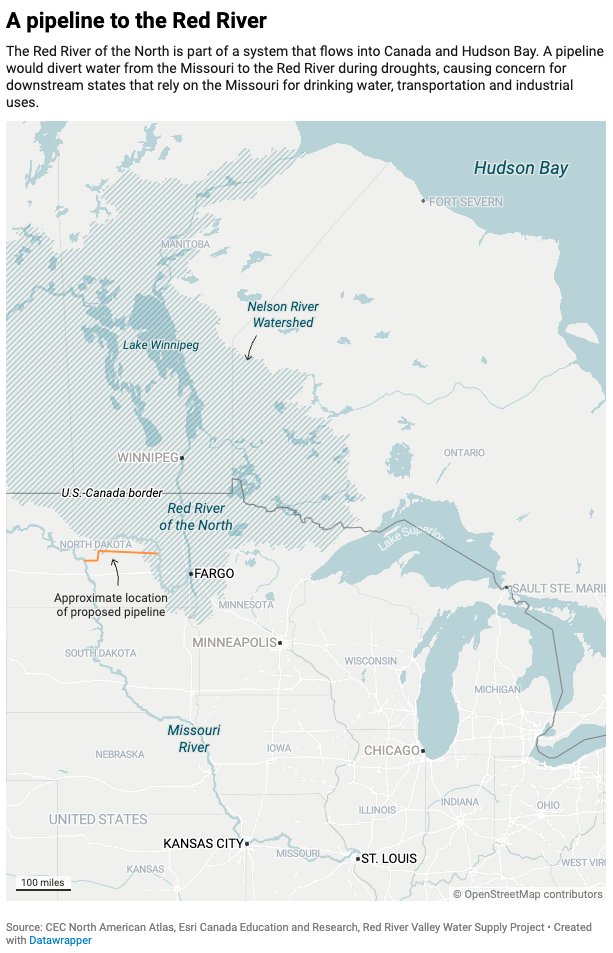
The North Dakota pipeline will be able to transport 165 cubic feet of water — around 1,230 gallons — per second. Haase said it would be expected to run at or near full capacity only during times of drought.
Kinne said the concern isn’t so much the impact of this project as what it might enable in the future.
“If you look at the North Dakota projects by themselves, you can argue they don’t have enough impact for us to be concerned,” he said. “The concern is the precedent that it sets, and these projects writing the playbook for other states and western states to access this water.”
As states in the western and southwestern U.S. struggle to reach an agreement on how to allocate water from the dwindling Colorado River, some in the Midwest are concerned they may begin looking to the Missouri River to meet their needs.
Even states within the basin have eyed Missouri River water as a potential solution to water shortages in other areas of their state, with Kansas and Army Corps officials studying the possibility of diverting the river to replenish the Ogallala aquifer.
If western states do divert water from the Missouri River, “it could be devastating,” said Garrett Hawkins, president of Missouri Farm Bureau.
“We understand that out west, the water situation is dramatically different, but we shouldn’t be looked at as the solution,” Hawkins said.
In 2025, Missouri lawmakers passed a law requiring a permit to export water and prohibiting the export of water via pipeline more than 30 miles beyond state borders.
Western “states are turning a thirsty eye to Missouri and other Midwestern states that are water-rich in order to get some of that water,” state Rep. Colin Wellenkamp, a St. Charles Republican, said during floor debate on the bill.
Ken Royse is the project manager for the Missouri River Joint Water Board, a coalition of North Dakota counties focused on protection and development of the river. He agreed that out-of-basin transfers to western states are the biggest threat to the Missouri River system.
“I think Missouri is trying to make a point that they’re watching it,” he said. “They’re worried about the precedent being set, and we are too. I think North Dakota has the same concern.”
“But our theory is, we’re a basin state,” he added. “We contribute water, we contribute land. We should be able to take water out to the extent that we don’t damage our downstream neighbors.”
Schaefer said he remains concerned about both precedent and the impact of the current project, which is “using federal dollars to help one state really to the detriment of other states.”
“With North Dakota seeking over $400 million to expand this project, we really don’t know … how much is going to be diverted,” he said.
|